Many beginners start with a small tank because it seems easier and cheaper. In practice, very small tanks are often harder to keep stable. A little more water gives you more room for mistakes, more fish choices, and healthier fish.
Affiliate Disclosure: This page contains affiliate links. If you purchase through these links, I may earn a small commission at no extra cost to you. As an Amazon Associate, I earn from qualifying purchases. This helps support Beginners Fish Keepers and allows me to keep providing free guides for new aquarium and fish keepers. I only recommend products I personally believe in and would use myself. Thank you for your support! Read our full affiliate disclosure.
Quick Answer
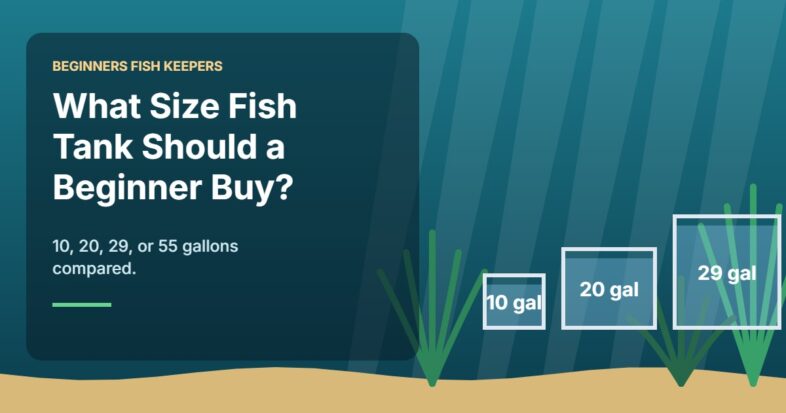
For most beginners, a 20 gallon tank is an excellent first aquarium. It is big enough to stay stable, small enough to fit most homes, and holds a nice community of small fish. A 10 gallon can work for a betta or a few tiny fish, and a 29 gallon gives even more options. Our review of the best aquarium starter kits for beginners compares popular setups.
Why Bigger Is Easier
- More stable water: waste, temperature, and chemistry change more slowly in more water
- More room for mistakes: overfeeding once or missing a water change is less likely to cause a crash
- More fish choices: many popular community fish need 20 gallons or more
- Happier fish: active and schooling fish need swimming room
Comparing Common Tank Sizes
5 Gallons
Best for a single betta, shrimp, or snails. Small tanks need careful, regular maintenance because water quality changes fast. Avoid bowls and tanks under 5 gallons for fish.
10 Gallons
A 10 gallon tank is affordable and fits on a sturdy desk or dresser. It suits a betta or a small group of tiny peaceful fish. It limits your choices and is less forgiving than a larger tank.
20 Gallons (Recommended)
A 20 gallon long has a wide footprint that gives fish more swimming room than a tall 20 gallon. It fits a school of small tetras, a group of corydoras, and a few other peaceful fish.
29 Gallons
A 29 gallon tank is a popular next step. It holds more fish and is very stable, while still fitting on a standard aquarium stand.
55 Gallons
A 55 gallon tank opens the door to larger fish such as angelfish and rainbowfish and bigger schools. It is heavy and needs a proper stand, but it is very forgiving once set up.
Things to Check Before You Buy
Weight
Water weighs about 8.3 pounds per gallon. With the glass, gravel, and decorations, a filled tank weighs roughly 10 pounds per gallon or more. A 20 gallon tank can weigh over 200 pounds, so use a stand or furniture made for that weight.
Location
- Keep the tank out of direct sunlight to avoid algae and temperature swings
- Choose a level, sturdy floor and stand
- Stay near an outlet, and use a drip loop on cords
- Leave room above and behind the tank for maintenance
- Avoid spots near heaters, air vents, and doors
Footprint
A longer, wider tank is usually better than a taller one of the same volume. It gives fish more swimming space and more surface area for oxygen exchange.
Total Cost
The tank is only part of the cost. You will also need a filter, heater, light, lid, substrate, water conditioner, and a test kit. See our guides to aquarium equipment and aquarium heaters. A starter kit can bundle several of these together.
What About Fish Bowls?
Bowls usually have no filter or heater, very little water, and a small surface area. Water quality changes quickly, and most fish do poorly in them. A small filtered and heated tank is a much better choice, even for a single betta.
Final Thoughts
If you have the space, start with a 20 gallon or larger tank. You will have an easier time keeping water stable, more fish to choose from, and a better chance of success. When your tank is ready, follow our beginner fish tank setup guide.
Have a question about your tank? Ask it in our friendly Facebook group, Beginners Fish Keepers, where new fish keepers help each other every day.